


















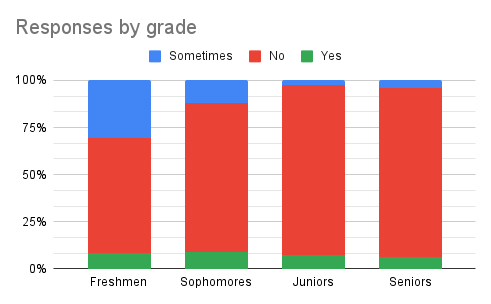
A recent Talon survey with over 150 responses revealed an intriguing pattern among SHS students: during the morning announcements, over 80% choose not to stand for the Pledge of Allegiance.
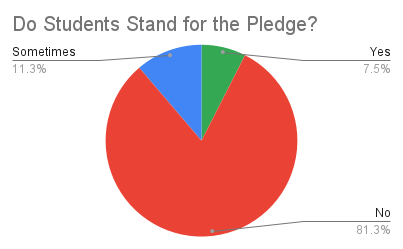
Many students will likely be unsurprised by this result; it reflects a reality they’ve been surrounded by for years. “Most students do not stand for the pledge in my classes,” confirmed an SHS history teacher. “One or two students might stand up, but it’s usually more of an anomaly.”
The trend of staying seated is not a universal one, though—at nearby schools, including Foxborough High, the norm is to stand. Mrs. Janey Goodwin, a teacher in Foxborough’s social studies department, said of her students, “Even with this political climate, most people just get up and do it, and I think that they’re used to it.” Goodwin added that while Foxborough students are generally expected to stand, “I would never have an issue if someone didn’t… I feel like they make their own choice.”
So what makes Sharon different? A chart of the reasons students gave for not standing, or for only sometimes standing, can be found below.
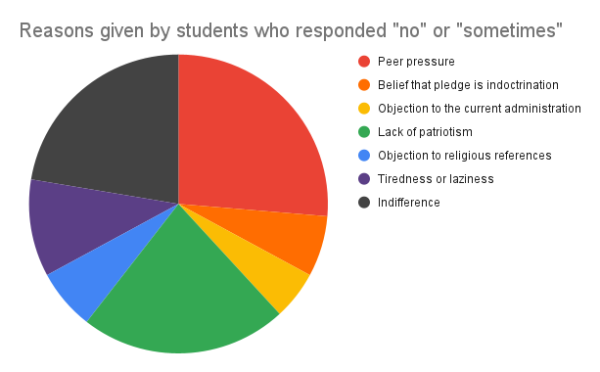
The most common reason given, accounting for over a quarter of negative responses, was peer pressure. One junior explained that they would feel embarrassed to be “the only one standing”; a freshman said that standing “sends the wrong message” about their political values. Another large group cited indifference. In the words of one sophomore, “I don’t really see the importance of pledging allegiance and I believe nobody else does either.”
“I don’t think we have a lot of conversation around this topic,” conceded the Sharon teacher after viewing these students’ comments. “Maybe bringing in historical examples would help people to understand why they’re doing what they’re doing a little bit more.”
It’s possible that teaching students about the pledge’s purpose could reduce peer pressure. But would it convince every student, or even the majority, to start standing up? Nearly a third of students cited a more personal reason for abstaining from the pledge: they object to the United States government, its current president, or even its founding values. Several pointed out that lines like “liberty and justice for all” don’t reflect the reality of racial and socioeconomic inequality in the United States. “This country no longer embodies what the pledge claims it does,” a student wrote. “I can’t stand every day for a lie like that.”
One freshman’s objection was to the problematic history of the Pledge of Allegiance itself—its author, Francis Bellamy, promoted its recitation in schools during the 1890s to preserve “true Americanism” and promote assimilation.
Notably, freshmen and sophomores were more likely to report standing or sometimes standing than upperclassmen, with a clear downward trend across the data. One explanation for this is that ninth graders are coming from the middle school, where behavioral expectations are more explicitly addressed; 25% of students who responded “yes” on the survey reported standing out of habit from their elementary or middle school days.
The most common reason given for standing, though, was respect for the U.S. as an institution, as well as its veterans and armed forces. “It’s really whatever I am thinking about that day,” a senior wrote. “Sometimes I stand because we are safe, and other times I think of people who paid the ultimate price to help our country.”
Can SHS teachers and administration find a way to address student concerns around the pledge? And if so, should they? “There [have] always been people who haven’t stood,” pointed out a Sharon teacher. While state law requires schools to lead a recitation of the pledge each day, students “have the constitutional right” to choose not to participate, the teacher said, adding, “Respecting people’s choices in either way is important.”
On the other hand, staying silent is only one way for students to express their beliefs. “A lot of people who have fought for civil rights, even if they’ve been unhappy with the direction of the country, have still felt pride in American values and principles,” the teacher pointed out. Whether or not students feel positively about the current political climate, they added, the pledge represents an effort to “make America live up to its stated values.”
The final results of the survey make one thing clear: Sharon students have something to say about the Pledge of Allegiance. The form’s anonymity likely encouraged students to express themselves more freely, revealing a wide range of personal values and opinions—which, our interviewee observed, could provide a basis for a meaningful in-class discussion. “People on both sides of the political spectrum are scared of things that they’re saying right now being taken the wrong way,” they said. “Hopefully the classroom is a place where people could talk about it.”